
"American coffee regions"
7000 article(s) found
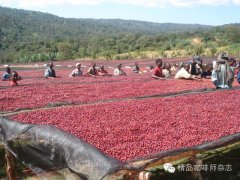
Costa Rica American Coffee Powles Volcanic Region
The global trend of modern coffee has gone through three popular stages. The first stage is from World War II to the 1960s, when instant coffee is represented by cheap coffee; the second stage is from the 1960s to the beginning of this century, when Starbucks is represented by commercial coffee; and the third stage is from the 1970s and has become a trend in the past decade.

American Coffee Manor Kona Coffee beans from Hawaii Coffee region of the United States have a rich flavor and aroma.
Flavor and taste characteristics: rich and fragrant taste, uniform acidity, full particles, with cinnamon aroma. When it comes to Hawaii, the first thing that comes to mind is the swaying palm trees and the vast flat sandy beaches, as well as the endless blue sky and blue sea. The unique beauty of Hawaii also gives local coffee a unique attraction. Hawaii is the only state in the United States that grows coffee.

American boutique coffee La Tisa Manor on the Farahan Plateau of Guatemala
Fraijanes Plateau: Waiqiang Plateau (Fraijanes Plateau) this area is of volcanic soil, high altitude, sufficient rainfall and great humidity variation. Ash from Pacaya, Guatemala's most active volcano, provides important minerals for the soil in the region. There is plenty of sunshine in the dry season, and although the clouds and dew are heavy in the morning, they dissipate quickly. Because of

Latin American Coffee Story the flavor characteristics of Latin American coffee how to drink Latin American coffee
Professional coffee knowledge exchange more information about coffee beans Please follow the coffee workshop (Wechat official account cafe_style) Coffee tree is a genus of Rubiaceae in botany. Coffee trees are native to subtropical Africa and some islands in southern Asia. In the 16th and 17th centuries, coffee was introduced into Europe through the merchants of Venice and the Dutch hegemony of the sea.

What's the flavor of American coffee beans? What are the coffee producing areas in America? Characteristics of American coffee
For more information on coffee beans, please follow the Coffee Workshop (official Wechat account cafe_style) the land bridge between Central and South America. There are seven countries, namely, Belize, Costa Rica, El Salvador, Guatemala, Honduras, Nicaragua and Panama. Coffee is produced in seven Central American countries, including Guatemala, Costa Rica and Hongdu.

Create the Central American market-six countries' boutique coffee will come out together.
Qian Zeng Aizhu, Ambassador of El Salvador to China, said that sa coffee, with a variety of unique coffee varieties and characteristics, is famous for its exquisite coffee in the world. In addition to the TSCC coffee association responsible for overall production and marketing operations, quality control and marketing overseas, in order to produce the highest quality coffee, there is also a Salvadoran coffee school, which aims to become a regional teaching and training center. 2016 sa

Introduction to Central American boutique coffee what is the flavor of coffee in the Caribbean?
Have you ever heard of a coffee belt? The so-called coffee belt refers to the area near the equator between the Tropic of Cancer and the Tropic of Cancer. This region is close to the equator and the innate climatic conditions are ideal, so most of the coffee producing areas in the world are in the "coffee belt". According to the world map, seven countries in Central America are in the coffee belt, including Belize, Guatemala, Honduras and Thrall.

An excellent balance of Ecuadorian Los Congo Manor coffee flavor taste characteristics of the region
From July 1927, Augusto. Cesar Sandinista led a guerrilla war against the American occupation, forcing the withdrawal of American troops in 1933. February 21, 1934 Nicaragua National Guard Commander Anastasio. Somoza. Garcia assassinated Sandino at the behest of President Roosevelt. He took office in 1936 and has since established a pro-American relationship for more than 40 years.

Nicaragua Coffee Estate Delight Estate Matagalpa Region
Because of the ethnic nature of the Latin American people, it is difficult for foreign buyers to do business directly with the Latin American people. The Latin American people do not attach importance to credit, do things too casually, the quality of shipments is not accurate, and the exported products are also adulterated with impurities. However, Latin America actually has a good planting environment suitable for planting agricultural products that envies the world. Therefore, we came to Nicaragua.

Central American coffee beans have unique environmental advantages. This paper introduces the differences and characteristics of coffee in several regions.
They are all distributed in the alpine slopes or plateau areas covered with volcanic ash at an altitude of 1200 meters. The coffee harvest and harvest season is from October to February of the following year. The coffee beans it produces belong to Arabica species, with Pacas and Bourbon brands as the main brands, belonging to big beans, with sweet taste and excellent flavor. El Salvador is also an important producer of organic coffee. Guatemala

Introduction to the flavor description and quality characteristics of Latin American coffee beans
What are the coffee beans in Latin America? Mexican coffee, from Cottpe and Veracruz in the north, to Plumas in the central Oaxaca region, to Chiapas in the southernmost, is a coffee-producing area, and the flavor of each region is also different. Although there are many producing areas in Mexico, but because the quality stability is not high, so we have to try in many ways to select the ones with high quality. Basically, Oaxaca and Oaxaca

Mexican coffee has a mild and delicate taste, American coffee beans.
Boutique coffee (specialty coffee) is also called specialty coffee selection coffee. It refers to coffee made from a small number of raw beans with excellent taste grown in an ideal geographical environment. Depending on the special soil and climatic conditions in which they grow, they have outstanding flavor. After strict selection and classification, this kind of coffee is hard in texture, rich in taste and stylish.

Flavor description of Honduran Coffee Bean introduction to the characteristics of taste manor by regional treatment method
Honduras Coffee Bean Flavor description Variety Regional treatment method Taste Manor characteristics Honduras declared its independence on September 15, 1821, but was incorporated into the first Empire of Mexico in 1822. He joined the Central American Union in 1823 and withdrew from the Central American Union in October 1838 to establish a republic. In 1840 Honduras, supported by Guatemalan dictator Rafael Carrera, was a conservative, Fran.

Introduction to the flavor description and processing method of Brazilian Huangbo single coffee bean price manor region
Brazil is located in the Latin American region of the Western Hemisphere, in the eastern part of South America and on the west coast of the Atlantic Ocean. Brazil is bordered by all countries on the South American continent except Ecuador and Chile. Most of its territory lies between the equator and the Tropic of Cancer and is the most tropical country in the world. Within the territory 1x3

How to taste espresso and American coffee
How to taste espresso and American Coffee Coffee first appeared in the sixth century AD in the town of kaffa in Ethiopia (present-day Ethiopia). The word coffee comes from here. It is said that because it was found to have a refreshing effect, the coffee fruit at that time was mainly for monks who prayed at night to avoid

Get to know the Coffee from six Central American countries: a detailed introduction to Guatemala Coffee beans
The temperature of Guardiola is about 15 degrees. Because of the long mountains and the great climatic changes in the region, Guardiola has created eight major coffee producing areas in the country, all located on the highland topography under tropical weather. The rainfall is stable, the fertile volcanic ash soil is in a good environment, and the coffee beans produced are all Arabica, each with different flavor and characteristics, and the first-class sour taste and fruit.

Flavor description of Honduran coffee beans introduction of regional treatment methods for taste and characteristics of varieties
The flavor description of Honduran coffee beans the characteristics of varieties produced by regions introduced Honduras declared its independence on September 15, 1821, but was incorporated into the first Empire of Mexico in 1822. He joined the Central American Union in 1823 and withdrew from the Central American Union in October 1838 to establish a republic. In 1840 Honduras, supported by Guatemalan dictator Rafael Carrera, was a conservative Francis.

Characteristics of Latin American coffee beans A brief introduction to Latin American coffee varieties
Mexico (Mexico) aroma 3 points of brightness 4 points of mellow 3 points of flavor 4 points of aftertaste 4 points suitable for baking: Full cityfull city, baking to the beginning of the pot, whether mixed with the formula to make Espresso or brewing single product, Mexican coffee beans can be said to have a unique flavor. Mexican coffee from Cottpe and Veracruz in the north to Plema in the central Oaxaca region.

Latin American coffee flavor Latin American coffee characteristics Latin American coffee taste
Latin America (Latin America) in 1721 French naval officer de Klee (Gabriel Mathieu de Clieu) experienced difficulties and obstacles to bring the first coffee sapling from Africa to the Latin American island of Martinique, which was the origin of coffee cultivation in Latin America. Because at that time, France was under the reign of the Bourbon dynasty, and Elaraby was grown in Latin America.

The National Union of Central and South American Coffee Diseases lend a helping hand.
The outbreak of coffee leaf rust in the coffee producing areas of Central and South America began at the end of last year, resulting in a reduction in local coffee production, which has seriously affected the local people's livelihood and economic industry. The National Cooperation Council of the Ministry of Foreign Affairs said that domestic plant pathologists have been invited to local friends to learn about the situation, and a regional plan will be planned to provide prevention and control assistance to friendly farmers through a combination of technology and funds.